Showing posts with label RESEARCH. Show all posts

Saturday, 22 February 2014

BURBERRY VS CHAVS- CALL FOR HELP

Today the brand is far from what it was back in the 00's, and its' beginning, when the company faced a huge crisis. The need to rebrand Burberry brought the new team of great professionals, including Christopher Bailey and Angela Ahrendts (retired to go to Apple last year). But how the brand was changed significantly can be proved by the sources such as LCF library, that provided me with a DVD of a BBC documentary on a problem of Burberry vs chavs.


source: http://news.bbc.co.uk/1/hi/business/4381140.stm


For a top luxury fashion company like Burberry it is the ultimate nightmare.
Their distinctive beige check, once associated with A-listers, has now become the uniform of a rather different social group: the so-called Chav.
With UK sales falling, Burberry cannot afford to become a laughing stock in their own backyard.
But just how does a top designer label shrug off a damaged image?
Only five years ago, Burberry was the darling of the fashion world after undergoing one of the most envied brand reinventions of recent years.
"It really tapped into a sense of the early years of the millennia," says Andrea Cockram of Verdict Research.
But all too quickly, the brand became a victim of its own success.
Label-conscious football hooligans started to adopt the distinctive check.
"It was associated with people who did bad stuff, who went wild on the terraces," says Peter York.
"Quite a lot of people thought that Burberry would be worn by the person who mugged them."

Welsh rap band, Goldie Lookin' Chain were given a Vauxhall Cavalier with a distinctive Burberry check paint job.
Nicknamed the "Chavalier", the car was being auctioned off on EBay until Burberry's lawyers got in touch demanding that the car be destroyed for infringing their copyright.
Burberry checked nails
Burberry is moving away from its traditional check

It was not only the car that was crushed, says band member Eggsy.
"I cried when they said you've got to destroy the car. What's next? Taking Rupert the Bear to court for having trousers that looked like Burberrys?"
There was more bad news earlier this year. Kate Moss, whose recent high-profile campaigns to promote the brand made her into the face of Burberry, is now facing tabloid allegations of drug-taking.
UK phenomenon
Burberry's Chief Executive Rose Marie Bravo is stepping down next year in favour of fellow American Angela Ahrendts, and the Chavs issue is likely to be near the top of her in-tray.
But there is reason for hope.
Most of Burberry's sales are overseas, so although sales in the UK have been sliding, international profits for last year reached over £160m.
Ms Ahrendts must be hoping that Chavs don't become a global phenomenon.


The Money Programme - Burberry versus The Chavs: broadcast on BBC TWO at 7pm on Friday 28 October.

Musicians Burberry fashion film

The idea of a rock concert and music is well depicted in the series of the videos.
As Bailey would say to WWD, Brit is the brand's line that they want to associate with music


Christopher Bailey's playlist

The CEO of the brand gave an idea of what songs he likes and the ones he associates with the brand.

https://play.spotify.com/user/guardianmusic/playlist/6eUSlXi2RtygX04xuskEtx


BURBERRY AND SHOWS. music's influence on their live events

here are the videos depicting some of the shows that can illustrate the idea of how the industry of music and fashion collapse and create something special for Burberry- it's attractiveness and the unmistakable new brand identity.

The company invites their Burberry Acoustic's new musicians' music


They invite singers to perform during the show (Tom Odell)


The latest show, 17th of February, 2014


BURBERRY's CEO about MUSIC and their brand


Burberry's Christopher Bailey on his obsession with music

For Burberry's chief creative officer, music is so important that the company now has its own full-time music team. The designer explains how his musical obsession drives his fashion work
by Laura Barton  source: http://www.theguardian.com/fashion/2013/sep/04/christopher-bailey-music-burberry-fashion
Since his arrival at the label in 2001, Bailey has made it something of a mission to entangle the worlds of fashion and music. It's there in the soundtracks to the shows of course, but also in the brand's advertising campaigns, featuring musicians such as Bryan Ferry, Patrick Wolf and Jack Bevan from Foals, George Barnett from These New Puritans and in a series of video performances by emerging and established artists named Burberry Acoustic.
The story of how Odell came to play such a key role in last February's show is not atypical. His music had been introduced to Bailey somewhere along the line – one of the many emailed links, demos, personal recommendations he receives each week. But Bailey had found himself so quickly smitten that by the time he was planning February's catwalk show, "I was just obsessively listening to his music. And even if I was listening to something else, I was listening to something that might've been in the Tom world … do you know what I mean?" he asks, looking faintly embarrassed, sitting on the edge of the sofa in his office at Burberry headquarters in London. "That weird musical obsession that you get, like a teenager."
Burberry Prorsum - Runway - LFW F/W 2013Bailey lined up Tom Odell to perform at the Burberry Prorsum autumn/winter show earlier this year. Photograph: Ian Gavan/Getty Images
It was, he explains, Odell's "sincerity and authenticity" that appealed. "I love that he's intense and I love that he believes in it and he's not playing at this. It's almost, I feel, more powerful than he is. It's transporting him."
When they met, he found Odell "warm, not introverted, but like a lot of musicians, quite awkward. He's not naturally gregarious and vivacious or demonstrative." But he saw too how Odell seemed to come alive when he played. "In his body language and everything – he becomes so intense and focused," Bailey says. "It's where everything kind of comes together."
There is a sweet inarticulacy to Bailey when it comes to speaking about music. "I find it very difficult talking about it," he apologises, "which is not helpful for this conversation. But it's because it's not tangible. It's like anything that's emotional, it's a feeling. But it's like the weather, it affects the spirit of everything."
And so our conversation is littered with words such as "authentic" and "emotive" and "organic", as if he is grasping desperately for the language to express his great passion. He talks about the transformative musical moments of his 42 years – his first gig at the age of 15, watching Bob Dylan, of those late teenage years driving around his native Halifax with his best friend, listening to cassette tapes. Of the Cure, and the Damned, Neil Young, Leonard Cohen, Joni Mitchell, Tracy Chapman, Everything But the Girl, Alison Moyet, Julia Fordham and Joan Armatrading, to whom he listens "probably every week".
But it is when he begins to explain the tactile effect of music that he grows more articulate. "I've always loved a pure voice or a pure instrument," he says at one point. "One of my favourite Elton John tracks is Skyline Pigeon. You just hear his voice and that piano and it kind of makes you crack inside, it's so beautiful. I actually love it when you hear someone's voice break," he says. "It suddenly feels like there's nothing else there but you and a voice." He looks faintly nervous, as if he might have said something silly, but I think there is something rather fitting about a fashion designer who experiences music as texture and sensation.
When he tells me later about asking Odell to perform at the catwalk show he recalls how he gave the musician notably tactile instructions: "I said this is a fashion show, and you've got, you know, girls walking up and down, but I want people to feel the music – I want them to have that feeling where the hairs on the back of your neck stand up. Because that's how I feel when I listen to music."
Tom OdellBritish singer/songwriter Tom Odell: Bailey was impressed with his 'sincerity and authenticity'.
It is music, he says, that "definitely, often, usually" before anything else "sets the directional mood for what we're working on." Though this often seems to happen subconsciously. "You listen to a piece of music, and something sticks but you don't realise," he says. "And you start working on things and it tends to permeate everything you're then doing at that moment."
It is in fact now such a key part of the Burberry process that the company now has its own full-time music team — two people who "really are musos" with whom Bailey can have "the most random conversations that I would be embarrassed to have with anybody else. I can talk to them about a feeling or a particular kind of voice and they will just suggest an artist."
It is the music team that also steers Burberry's ongoing commitment to emerging musicians — not just with projects such as Burberry Acoustic but, as Bailey is keen to explain, in the way that the company "work on a lot of things that we don't show with musicians, matching artists up with the right management and record labels and things. It's a very authentic relationship, they know that we respect them."
It is in many ways an extension of the role Bailey has carved out for himself in the worlds of art and architecture, as well as fashion, nurturing young talent and burgeoning creativity from his work with the label's youth charity the Burberry Foundation, to his role as mentor at a number of institutions, from the Royal College of Art to the University of Huddersfield. "It's what I enjoy," he explains. "It's really selfish. But I'm in a really privileged position to do it. And my dream was always to build a design school that has all the different worlds that make you feel – from the design of clothes or a pair of sunglasses or shoes or bags, to furniture, architecture, web design, event design, physical space design, retail and offices, to packaging and video and photography, print, colour, textiles, music. Because they're all the senses. That's what I try to build up. Because I love working with people that feel and that care."
This is not perhaps a conventional route for a fashion design company, but it seems to be successful – last year, Burberry's total revenue was £2bn, with retail revenue up 12% and it now has a total of 533 stores worldwide, including the 44,000 sq ft flagship store in London. "Lots of people think that as a big public company your whole reason to be is about the business and about finance," Bailey says. "But actually I feel that if you have a spirit and a point of view, if you have people who are united and are joyously doing something that they love … well, then it's like the chicken and egg," he smiles. "It's nothing to do with money. It's just something that we love to do. It makes you real. And it's not cynical. We're not trying to flog things off the back of these things."
Back at Kensington Gardens last February, the day before the catwalk show, Bailey stood to watch Odell rehearse. "It was about four o'clock in the afternoon," he remembers. "There were technicians, lighting people, photographers preparing, cleaners cleaning … it was a chaotic thing. But then Tom started to play and the whole place just went completely silent and stood still. And I stood there, trying not to show that I was getting a bit emotional – but it was just one of those moments: Tom could've been at home alone in his bedroom, he just completely went into lockdown, into what he was doing. He completely made sense, and I was just blown away."
I wonder where Bailey, sitting atop this business empire, this design school, this great swirl of fashion and music and art, feels he makes most sense. He frowns. "I guess it's in those moments – whether you're fitting the collections or whether you're working on a building or whatever kind of thing you're doing, where everything becomes so unimportant because that feeling, that idea is so powerful," he says. "You might have tonnes of worries about other things and you're really crazed and you're busy and life is chaotic. But all of a sudden you don't care about anything else. That example of Tom playing in rehearsal was one of them. Nothing else mattered. And those moments you have to cherish'

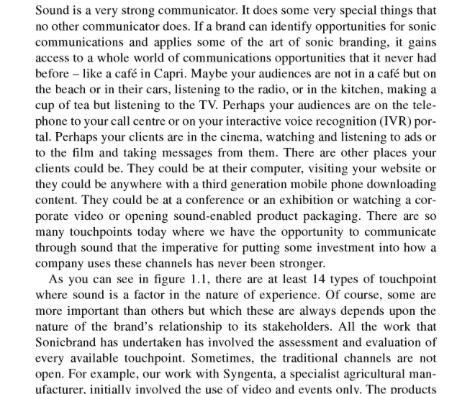
Sonic Branding / Daniel Jackson. (for Research)

important abstracts that can explain sonic branding


source: google books

BURBERRY. RESEARCH ON MUSIC AND THE BRAND

HERE IS SOME INFORMATION FROM THE WEB-SITE, PROVING THE MUSIC HAS BEEN A HUGE PART OF THE STRATEGY OF THE BRAND

and Also an interview with the musician that was a part of Burberry for their branding strategies.


ENGAGING MUSICIANS IN THEIR CAMPAIGNS WAS ONE OF THE KEY STRATEGIES


I INTERVIEWED ONE OF THE 'FACES' FROM AW2011 CAMPAIGN, MY FRIEND

  MATTHEW WHITEHOUSE OF THE HEARTBREAKS FOR THIS RESEARCH


HOW DID YOU START COLLABORATION WITH BURBERRY?

 An intern who was over from New York happened to catch a Heartbreaks show at Proud Galleries in Camden one night and decided put my name forward for the campaign. Horseferry House got in touch, I went for a cup of tea with Christopher Bailey and the rest, as they say, is history.

HOW DOES IT FEEL TO BE A PART OF FASHION WHEN INITIALLY YOU START AS A MUSICIAN?

I think Burberry use musicians in a very positive way. Never once, as it easily could with a brand so large, does their use of music feel exploitative. On the contrary, it always feels collaborative and born from a genuine love of that very British link between fashion and music. 

WHAT DO YOU THINK ABOUT BURBERRY'S STORES AND THE WAY THEY ARE PRESENTED?

Everything Burberry do, they do to the highest possible standard and by that I mean, when they put on a show, the sound is always good, the lighting is always good and the production is always good. I think, with a brands physical presence on the high street obviously becoming less and less important, encouraging consumers to view their spaces in different ways is vital.

WHAT IS SO IMPORTANT ABOUT THEIR RETAIL PRESENCE?

 As touched upon above, allow customers to use stores in a more immersive way is going to be very important in the future. Rolling out some of the features from their flag-ship Regent St store, for example, could be how they achieve this.


FML Burberry. Rebranded. New brand with a strong identity

The reason Burberry is discussed in my essay is because it is one of the strongest brands, that managed to change itself. One of the reasons was music and sound.
However, here are some official statistics to prove the brand can be a good example and a case study on how they approached sound to translate the brand is relevant.


^Disclaimer
This Annual Review does not constitute a summary financial statement for the purposes of sections 426-8 of the Companies Act 2006. A copy of the Burberry Group plc Annual Report and Accounts 2012/13 can be viewed free of charge, online at burberryplc.com.

This document contains certain statements that are forward-looking statements. They appear in a number of places throughout this document and include statements regarding our intentions, beliefs or current expectations and those of our officers, directors and employees concerning, amongst other things, our results of operations, financial condition, liquidity, prospects, growth, strategies and the business we operate. By their nature, these statements involve uncertainty since future events and circumstances can cause results and developments to differ materially from those anticipated. The forward-looking statements reflect knowledge and information available at the date of preparation of this document and unless otherwise required by applicable law the Company undertakes no obligation to update or revise these forward-looking statements. Nothing in this document should be construed as a profit forecast. The Company and its directors accept no liability to third parties in respect of this document save as would arise under English law. This document does not constitute an invitation to underwrite, subscribe for or otherwise acquire or dispose of any Burberry Group plc shares, in the UK, or in the US, or under the US Securities Act 1933 or any other jurisdiction.


BURBERRY STRATEGY


Enhance consumer resonance and operate more effectively through exacting use of brand assets and coordinated action across the global organisation. One brand, one company.

Key highlights from 2012/13 include:

Brand momentum

Ensuring the strength, purity and positioning of the Burberry brand remained a priority.
Burberry World Live
  • Burberry Regent Street opened in London in September 2012 as the brand’s most comprehensive expression to date. Introducing the concept of ‘Burberry World Live’, Regent Street blurred the physical and the digital to bring all aspects of burberry.com (‘Burberry World’) to life in a meticulously-restored heritage space.
  • Offering the full collection in a digitally-enriched environment, Regent Street engaged customers with brand content continuously projected on over 100 screens throughout the store, including product-specific content triggered by RFID-enabled merchandise on mirrors that turn instantly to screens. In-store audiences could watch key brand moments live from other locations, including the womenswear S/S13 and A/W13 runway shows.
  • Regent Street also gave physical expression to the brand’s most innovative digital launches. This included live music events featuring Burberry Acoustic artists and the first in-store Burberry Bespoke experience.
Beauty
  • In October 2012, Burberry announced the transition of its fragrance and make-up business from a licensed to a directly operated structure.
  • As consumers’ most widely encountered expression of the Burberry brand, Beauty provides outstanding growth opportunities for the Group. Business integration was completed during the year with operations commencing on 1 April 2013. 
Digital
  • Investments in burberry.com continued with expanded delivery to over 100 countries, while the introduction of Spanish and Korean brought the number of languages online to eight.
  • Retail theatre was rolled out to a further 84 stores, extending the global streaming of brand content in all flagship markets.
Brand recognition
  • Listed in Interbrand’s ‘Top 100 Global Brands’ for the fourth consecutive year, Burberry was named the luxury fashion brand with the greatest increase in brand value. Burberry was cited by Altagamma as the luxury brand with the highest digital customer awareness and led media think tank L2’s ‘Fashion Digital IQ Index’ for the second year, as well as being named by L2 as the fashion brand with the highest ‘digital IQ’ in China. LinkedIn ranked Burberry the 29th most in-demand employer globally.

Marketing innovation

Continued extension of its reach through marketing innovation, leveraging brand content to engage and connect global audiences.
Digital engagement
  • Brand excitement was driven globally across a range of platforms. The S/S13 main campaign generated record awareness through social and traditional media, with the launch video generating over 1.7 million views
    on YouTube and Burberry trending globally on Twitter. The womenswear A/W13 show was streamed live on Twitter for the first time, allowing followers to embed the show stream in personal newsfeeds.
  • Burberry finished the year as the most followed luxury brand on Facebook, with nearly 15 million fans. Total lifetime YouTube video views reached nearly 24 million and the brand’s combined Twitter following was over two million. Burberry was also the leading luxury lifestyle brand on Instagram.
Outdoor investment
  • Investment was increased in out-of-home marketing in key markets. To emphasise the brand’s association with weather, Burberry streamed live images of London scenes simultaneously throughout the Olympic period to prominent outdoor sites in London, Paris, Hong Kong, Los Angeles and New York.
  • The Art Of The Trench social media platform was taken to outdoor spaces in London and Chicago in conjunction with flagship store launches.
  • More broadly, the brand secured key airport and iconic urban locations on a long-term basis.

Product excellence

Burberry creates great product through intensive focus on design innovation, quality and core heritage icons.
Outerwear
  • Outerwear is the core of the apparel business, underpinned by monthly fashion groups and a robust replenishment programme. Leveraging the brand’s unique heritage together with design innovation and excellence, outerwear accounted for about 50% of mainline apparel sales. The iconic trench coat continued to be a central feature of the brand’s marketing activities.
Mens
  • Investments in infrastructure saw increased product and marketing excellence in men’s outerwear, London and Brit. As the fastest growing product division, mens represented 24% of retail/wholesale revenue.
  • Retail sales of men’s tailoring, available in over 70 mainline stores, grew by nearly 70% year-on-year and the first dedicated standalone mens store opened in Knightsbridge, London.
Product hierarchy
  • Burberry Prorsum and London continued to outperform, reflecting customer preferences and representing about half of womens and mens mainline retail sales. 
  • An ongoing focus on innovative product, marketing and merchandising and a shift in the product pyramid mix drove growth in mainline average unit retail prices.
  • Runway Made to Order launched, continuing to put the Burberry customer at the centre of increasingly personalised luxury experiences. Engraved nameplates could be added to outerwear and bags from the womenswear A/W13 collection. Smart personalisation technology was introduced to unlock bespoke digital content relating to each item on touchscreen devices.

Monday, 25 November 2013

FUTURES. RESEARCH


This article was downloaded by: [University of the Arts London]
On: 25 November 2013, At: 11:04
Publisher: Routledge
Informa Ltd Registered in England and Wales Registered Number: 1072954 Registered office: Mortimer House, 37-41 Mortimer Street, London W1T 3JH, UK

page1image3584
Consumption Markets & Culture
Publication details, including instructions for authors and subscription information: http://www.tandfonline.com/loi/gcmc20
Retail stores as brands: performances, theatre and space
Alfons van Marrewijk a & Maaike Broos a
a VU University Amsterdam , The Netherlands Published online: 03 Feb 2012.
page1image7120
To cite this article: Alfons van Marrewijk & Maaike Broos (2012) Retail stores as brands: performances, theatre and space, Consumption Markets & Culture, 15:4, 374-391, DOI: 10.1080/10253866.2012.659438
To link to this article: http://dx.doi.org/10.1080/10253866.2012.659438
page1image10072 page1image10232
PLEASE SCROLL DOWN FOR ARTICLE
Taylor & Francis makes every effort to ensure the accuracy of all the information (the “Content”) contained in the publications on our platform. However, Taylor & Francis, our agents, and our licensors make no representations or warranties whatsoever as to the accuracy, completeness, or suitability for any purpose of the Content. Any opinions and views expressed in this publication are the opinions and views of the authors,
and are not the views of or endorsed by Taylor & Francis. The accuracy of the Content should not be relied upon and should be independently verified with primary sources
of information. Taylor and Francis shall not be liable for any losses, actions, claims, proceedings, demands, costs, expenses, damages, and other liabilities whatsoever or howsoever caused arising directly or indirectly in connection with, in relation to or arising out of the use of the Content.

This article may be used for research, teaching, and private study purposes. Any substantial or systematic reproduction, redistribution, reselling, loan, sub-licensing, systematic supply, or distribution in any form to anyone is expressly forbidden. Terms & Conditions of access and use can be found at http://www.tandfonline.com/page/terms- and-conditions
page1image21512 page1image21672
page2image392
Consumption Markets & Culture
Vol. 15, No. 4, December 2012, 374–391
Retail stores as brands: performances, theatre and space
Alfons van Marrewijk∗ and Maaike Broos VU University Amsterdam, The Netherlands
The scholars of Consumer Culture Theory studies as well as practitioners have recognised the potential power of spatial design in stores in constructing and com- municating retail brands. Retail space and the aesthetic structuring of a range of expressive artefacts have become the stage on which shop attendants perform. This paper focuses on how management and shop attendants of Dutch menswear fashion house Oger communicate and construct the Oger brand, with a special focus on the spatial settings of the retail store. This study shows how the manage- ment carefully combines elements generally found in Italian ateliers, English gen- tlemen’s clubs and boardrooms. The symbolic message behind the spatial design of the Oger flagship store is that of human quest for wealth and fame removed from the everyday life. In addition to this earlier observed interplay between design, display and consumption processes, this study indicates the important role of shop attend- ants in constructing and communicating retail brands. By forging links with organ- isation studies, we show how retail management carefully designed, managed and orchestrated retail space, objects and shop attendants’ roles to construct and com- municate the Oger brand. The selling of products through performances in designed theatres connects organisation and economic and aesthetic realms. Finally, the paper introduces “internal design proxemics” as an extra analytical concept of spatial settings.
Keywords: space; retail store; brand; theatre; performance; visual ethnography
Introduction
Consumer Culture Theory (CCT) is increasingly focusing on the potential power of spatial settings in terms of communicating fashion brands (e.g. Olins 1989; Crewe and Lowe 1995; Schmitt, Simonsen, and Marcus 1995; Miller et al. 1998; Schmitt 1999; Smith 2000; Gregson, Crewe, and Brooks 2002a; Turley and Chebat 2002; Kent 2003; Schroeder 2003). CCT studies define branding as the process by which a cultural work is designed and communicated to function as its own advertisement in order to create an audience (Lury 2004). As branding is currently the dominant strategy around which retail competition is structured, retailers use the material environment of retail stores to distinguish themselves from their competitors (Smith 2000; Gregson, Crewe, and Brooks 2002b). This is done through the architec- tural design of shopping malls, retail shops and interior retail spaces (Olins 1989), with fashion houses, clothing stores and shopping centres attracting special attention (Kent 2003). Examples of innovative retail architecture can be found in Prada’s flag- ship stores in New York, designed by Rem Koolhaas, in the fashionable Aoyama dis- trict in Tokyo, designed by Jacques Herzog and Pierre de Meuron, and finally in the
∗Corresponding author. Email: a.h.van.marrewijk@vu.nl
ISSN 1025-3866 print/ISSN 1477-223X online # 2012 Taylor & Francis http://dx.doi.org/10.1080/10253866.2012.659438 http://www.tandfonline.com
page2image25296
Downloaded by [University of the Arts London] at 11:04 25 November 2013
Consumption Markets & Culture 375 ESPN Zone. Kozinets et al. (2002) described the architecture of this zone, demon-
strating that the building:
is constructed around a circular theme, such that the gently curving lines on the periphery always return to their originating point. At the centre of the circle is the “production booth” in which the programmer sits, surrounded by monitors, deciding which sports events (and, occasionally, other programmes such as soap operas) will be broadcast on the dozens of embedded screens. With a curved sky-painted dome, a stratospheric cathe- dral ceiling reminiscent of natural and spiritual realms, a circular staircase and a circular logo-embedded rotunda, the circle is multiply present within ESPN Zone. (Kozinets et al. 2002, 22)
The symbolic message behind the circularity as expressed in the ESPN Zone is one of human continued attempt to grasp eternity, completion and infinity (Kozinets et al. 2002). This example typifies how a built environment may use the concept of circular- ity to create a brand on a physical level. Thus, spatial settings and the aesthetic structur- ing of a range of expressive artefacts are increasingly pervasive components of the construction and communication of brands (Pen ̃aloza 1998).
Within CCT, servicescape studies generally include environmental dimensions such as ambient conditions (noise, music and aromas) and space (design, layout and furnishing) as well as signs and symbols (style and personal artefacts) (Bitner 1992). In the space dimension, a special emphasis is placed on the impact of spatial design and physical environments on customers and employees (e.g. Bitner 1992; Habraken and Teicher 1998; Pen ̃aloza 1998; Sherry 1998; Sherry et al. 2001; Arnould and Thompson 2005; Rosenbaum 2005). Pen ̃aloza (1998), for example, studied Niketown and showed how its architectural design with atriums, passageways and concept rooms helped siphon consumers through the place, providing multi-sensorial stimulation at every turn and thus inviting imaginative associations. Other examples include the socially constructed meaning of place in Creigton’s (1998) study of the Japanese retail store SEED and Sherry’s (1998) study of Niketown. We learn that the spatial design of retail space not only influences consumers’ and shop attendants’ behaviour but also, in return, gives a symbolic meaning to spatial design (Rosenbaum 2005; Schembri and Boyle 2005). In their study of the American Girl brand, Diamond et al. (2009) found that the brand was located within a complex system of sources with connections that are not linear and causal but rather probabilistic and reciprocal. Retail space is thus “brought into being, orchestrated, performed in interaction and, as negotiated, is accepted, resisted and interpreted by both consumers and shop attend- ant” (Gregson, Crewe, and Brooks 2002b, 1663). If brands represent symphonies of meaning, managers must be viewed as orchestrators and conductors as well as composers, whose role is not only to coordinate and synchronise but also to create (Diamond et al. 2009, 131).
Let us now take a closer look at the shop attendants and their interpretation of spatial settings (Turley and Chebat 2002; Pettinger 2004). Recently, organisation and management studies have placed spatial settings for work and their effects on employees centre stage (e.g. Hernes 2004; Kornberger and Clegg 2004; Hernes, Bakken, and Olsen 2006, Rafaeli and Pratt 2006; Strati 2006; Yanow 2006; Dale and Burrell 2008; van Marrewijk and Yanow 2010). These studies teach that spatial settings in organisations shape action and interaction by employees and in turn are reshaped on the part of these employees. The production and reproduction of space are what Hernes, Bakken, and Olsen (2006) called the recursive view on organisational
Downloaded by [University of the Arts London] at 11:04 25 November 2013
376 A. van Marrewijk and M. Broos
space. In summary, it can be stated that shop attendants form an important factor in the shaping of retail space.
In view of the above, it can be argued that a recursive view on retail space and shop attendants in the construction of retail brands has been understudied, despite a number of earlier investigations (e.g. Olins 1989; Crewe and Lowe 1995; Schmitt, Simonsen, and Marcus 1995; Pen ̃aloza 1998; Sherry 1998; Schmitt 1999; Smith 2000; Gregson, Crewe, and Brooks 2002b; Pettinger 2004, Diamond et al. 2009). In this paper, we seek to answer the call for empirical studies (Gregson, Crewe, and Brooks 2002a; Ku ̈pers 2002) on space and spatial arrangement(s) in retail shops as used to construct and to communicate a brand.
This theoretical exploration leads to this paper’s research question concerning the way in which a brand is communicated and constructed by management and shop attendants, with a special focus on the spatial settings of the retail store. To answer this question, we investigated the Dutch Oger fashion store, the leading menswear retail company in the Netherlands. We selected Oger because personal service is more extensive in top market segments as stores become more and more exclusive (Pet- tinger 2004). In addition, clothing stores and shopping centres tend to attract the most design attention (Kent 2003). We were allowed to film the interaction between custo- mers and shop attendants as well as backstage work processes. The visual recording of events, rituals, physical settings and interviews has proven to be highly useful in con- sumer research (e.g. Emmison and Smith 2000; Belk and Kozinets 2005). In addition to filming events, this study engaged in qualitative ethnographic research in terms of par- ticipant observation, observation and interviewing.
Thus, this paper forms an extension of previous studies of spatial settings in CCT literature. Earlier studies (e.g. Pen ̃aloza 1998; Kozinets et al. 2002) have observed the interplay between design, display and consumption processes in constructing and com- municating retail brands. By forging links with organisation studies, our study adds the important role of the staff members in constructing and communicating a retail brand. The findings of our study show how Oger management carefully designed, managed and orchestrated retail space, objects and shop attendants’ roles to construct and com- municate the Oger brand. Furthermore, this paper introduces “internal design proxe- mics” as an extra element of Yanow’s (2006) analytical concept of spatial settings and helpful in the analysis of spatial shop design.
The paper is structured as follows. First, a theoretical discussion is presented on the performance of shop attendants in the spatial settings of a retail theatre. The methodo- logical section addresses the question how spatial settings can be studied in retail stores and theorises about the use of film as a research tool. Next, the case of Oger fashion is discussed and findings are presented. Our discussion presents the spatial settings and the sociomaterial performances that construct the Oger fashion brand. Finally, con- clusions are drawn on the production of retail space.
Performances in the retail theatre spatial settings
In developing retail shops, retailers and designers have converted the ordinary experi- ence of consumers into a form of entertainment and hedonistic experience (Miller et al. 1998). The store offers consumers exclusiveness and authenticity by creating factual and spatiotemporal links. In their study on coffee establishments in Sweden and Denmark, for example, Kjeldgaard and Ostberg (2007) found three types of brands, which they called “americana,” “culinaria” and “viennesia,” referring to places of
Downloaded by [University of the Arts London] at 11:04 25 November 2013
origin. For example, the “culinaria” establishments mainly refer to Italian names, Italian de ́cor, with baristas from Italy and menus written entirely in Italian to reinforce their Italian identity. In doing this, retail space has become a show stage attracting consumers and allowing retailers to charge a premium price for what may be termed commodity products or services (Kent 2003). Dovey (1999, 15) called this seduction the most subtle and embedded form of spatial power in which people identify themselves with specific spatial settings. Here, one might think of a beautiful up-market shopping arena, a cool and aesthetically pleasing space that draws one into its folds through the delights of the market that it contains – if only one strolls through and lets oneself go with the unfolding spectacle of beauty, fashion and scents. Galle ́rie Lafayette in Paris would be such an example. In summary, retailers now frequently use the meta- phor of the retail shop as a theatre (Baron, Harris, and Harris 2001).
The notion of retail experience as a theatrical experience has been discussed in earlier marketing and consumer literature (e.g. Fisk and Grove 1996; Pen ̃aloza 1998; Sherry 1998; Baron, Harris, and Harris 2001; Kozinets et al. 2002; Grandey 2003). These studies frequently refer to theatre concepts such as front-stage, backstage, scripts, roles and settings in the context of service encounters, which originates from Goffman’s (1959) dramaturgical perspective on human behaviour in everyday life. This perspective allows us to understand how a theatre removes consumers from every- day life and isolates them in a constructed environment in order to create a unique and aesthetic experience (Fisk and Grove 1996; Gagliardi 2009).
To this end, shop attendants need a mixture of scripted role-playing and improvisa- tion (Sherry et al. 2001, 502). They have to create, clearly visible to all visitors, a drama performance in the spatial settings of a retail theatre (Fisk and Grove 1996). This per- formance of service is a continual and forced repetition of organisational norms that have the effect of embedding and stabilising cultural practices (Schembri and Boyle 2005). It means that shop attendants need the capacity to perform services as emotional labour (Ashforth and Humphrey 1993). Here, emotional labour is the display of expected emotions by shop attendants during service encounters. It is performed through surface acting, in which emotions are a careful presentation of learned verbal and non-verbal cues, and through deep acting, in which one actually experiences the emotions that one displays (Grandey 2003).
At this point, it has to be noted that employees in the retail industry are generally not used to performing scripted role-playing in retail theatres. Traditionally, they receive low wages, are bored with their work and unmotivated, and they frequently resign from work (Baron, Harris, and Harris 2001, 112). Therefore, employees are commonly trained to be actors, to perform corporate acts, to interact with customers and to involve with the store and its products. These roles played by shop attendants in the retail theatre are related to consumer roles.
In this respect, Baron, Harris and Harris (2001) introduced new concepts to denote four different roles that consumers can play in a retail theatre, namely “voyeur,” “spect- actor,” “sense-ceptor” and “connoisseur.” For each of these roles, employees have to act differently. First, in what Baron, Harris and Harris (2001) called the consumer as voyeur, there is minimum employee–consumer interaction, and employees perform backstage roles (supplying products when required and changing environments) or front-stage roles as characters in a scenario. Second, in the case of a consumer as spect-actor, both customers and employees are fully aware of their roles, with employ- ees acting as the primary facilitators of information exchange among customers rather than acting as experts in the field presented. Third, in the case of a consumer as sense-
Consumption Markets & Culture 377
Downloaded by [University of the Arts London] at 11:04 25 November 2013
378 A. van Marrewijk and M. Broos
ceptor, employees are backstage, handling merchandise, as well as front-stage, acting as assistants, advisers and facilitators in trials. Finally, with the consumer as connoisseur, employees play front-stage roles as human exhibits, interacting creatively with custo- mers, as well as backstage roles, changing the environment (Baron, Harris, and Harris 2001). In summary, for each type of retail theatre, shop attendants need to display distinct roles.
We have now gained insight into the role-playing expected from employees, but how is this related to spatial settings in retail theatres? Diamond et al. (2009, 131) stated that powerful brands are the product of dynamic interaction among multiple sources and, therefore, suggest a more complete and holistic understanding of sociocul- tural branding. In line with this view, we feel that a stringent demarcation between con- sumption phenomena and their context is not possible and not desirable (Pen ̃aloza 1998). On the contrary, it is especially a holistic analysis of spatial settings and social behaviour that results in a better understanding of organisations (O’Toole and Were 2008). Therefore, the social and the material should no longer be seen as distinct and largely independent spheres of organisational life (Latour 1993; Orlikowski 2007). Increasingly, tacit meanings of material forms interact with consumers in retail theatres (Kozinets et al. 2002). Pen ̃aloza (1998), for example, described how sculptures, glass and wooden cases, lighting and the use of velour ropes and other theatrical props, such as cables suspending athletes’ portraits from the ceiling, were effective in invoking a new reality for consumers and shop attendants. This sociomaterial perspective of retail theatres is helpful in studying the material and symbolic stage as well as the social performance displayed by shop attendants in constructing and communicating the Oger brand.
Methodological reflections on studying organisational spaces
Key methods used in CCT are ethnographic research and qualitative data collection focusing on the experiential and sociocultural dimensions of consumption that are not plainly accessible through experiments, surveys or database modelling (for an over- view, see Arnould and Thompson 2005). Similarly, in our study, these methods have played a key role as well. We used ethnographic methods of participative observation, non-participant observation, systematic data collection, recording and filming in a natural setting (Arnould and Wallendorf 1994; Yanow and Schwartz-Shea 2006).
In view of the above, it must be noted here that ethnographic literature emphasises the ways in which the researcher himself or herself is the primary research “tool,” because the researcher’s self is not separable from interpretations and events (Van Maanen 1995). We believe that empathic understanding presupposes an emic perspec- tive: the researcher studies the organisation “from within” and puts himself (or herself) in the employee’s shoes (Wallendorf and Belk 1989; Yanow and Schwartz-Shea 2006). Researchers might then gain a “feel” for organisational behaviour within the spatial set- tings of an organisation (Strati 1999; Warren 2008). In this way, researchers themselves can become valid sources of data through their own experiences, refining their capacity to empathise with others and imagining what it might be like to be them walking through and/or working in these same spaces (Warren 2008, 563).
In this way, initial observations have been made concerning location, atmosphere, in-store design, retail space, clothing, uniforms and customers. Our field research started with a guided tour of the Oger Fashion stores in Amsterdam. Following this introduction, we spent 2 months observing shop attendants and customers in the
Downloaded by [University of the Arts London] at 11:04 25 November 2013
Amsterdam-based Oger flagship store and during fashion presentations held by Oger Lusink in The Hague and Amsterdam. Furthermore, desk research was carried out to understand the history, development and vision of the fashion house. We analysed the Oger website, newspaper and magazine articles, and television interviews as well as two television documentaries on the fashion.
In general, researchers access space through observing spatial vocabularies, with whatever degree of participation, and then through interpreting them (Joy and Sherry 2003; Warren 2008; van Marrewijk 2009). To analyse spatial vocabularies, Yanow’s (2006) analytical concept for the study of organisational space is applied here. She pro- posed a systematic analysis of space and physical arrangements by means of four differ- ent categories. First, her “design vocabularies” concern a building’s shape, height, width, mass, scale and material and involve a situation-specific comparison of similarities and differences with surrounding buildings. Second, what Yanow called “design gesture” concerns design elements that ignore, contrast or align with surrounding buildings and spaces. Third, her “design proxemics” incorporate the context of culturally specific meaning and involve the social and personal spaces between people that shape human behaviour and interaction. Finally, “de ́cor” includes not only furnishing, furniture, art, chairs, statues and photographs but also dress codes and hairstyles (Yanow 2006). These four categories were used in our study and amended to include what we term “internal design proxemics” as an extra element in design proxemics.
In our preliminary investigations, we analysed data gathered during the first 4 weeks on the basis of traditional ethnography, which offered us a framework for filming the Oger theatre. From the first analysis, a series of important topics emerged: street facade, interior design, customer and shop attendant interaction, special boardroom treatment for exclusive clients, backstage control, management philosophy and, finally, the Oger Academy. Visual media were used for further data collection. As was stated in the introduction, filming is an effective and reliable method for the observation of interaction between customers and shop attendants within the spatial settings of a retail store. This enabled us to use camera shots, stills and slow-motion pictures to analyse and to reanalyse, if necessary, behaviour in the greatest possible detail. Film registration allows the researcher to concentrate on different aspects of the image and to recognise diverse and subtle details which would otherwise have been missed (El Guindi 2004; Belk and Kozinets 2005). Our film shoot was taken during 2 full weeks by a cameraman – a student of the School of Arts working on his examination project – and a freelance sound technician. Scenes to be filmed were based upon the topics discussed earlier. Similar techniques have been used by Collier (1967), Barbash and Taylor (1997), Ruby (2000) and Belk and Kozinets (2005).
Still, in view of the above, it must be stated that the presence of audiovisual media may hinder the interaction between researcher and field of study (Pink 2007). In our case, however, this phenomena proved to be of little influence because the people we filmed (many of them were media and soccer stars) had a wide experience with public exposure. We had permission to openly film customers in the shop but were not allowed to interview them, as they wanted to go about their business undisturbed. Customers were always asked permission before filming. It took shop attendants approximately 3 days to become used to the camera presences in the store.
In-depth interviewing is generally viewed as an important part of market-oriented ethnography (Arnould and Wallendorf 1994). During the shoots, in-depth interviews were held – and filmed – with founder Oger Lusink, his two sons, two management
Consumption Markets & Culture 379
Downloaded by [University of the Arts London] at 11:04 25 November 2013
380 A. van Marrewijk and M. Broos
team members and five shop attendants. We chose not to be filmed ourselves when con- ducting research as our main focus lay on the interaction between shop attendants and consumers. Film shoots started at 8.15 a.m. and lasted until 9.00 p.m., resulting in 22 tapes with a total of 17 h of film.
It is a well-known fact that the analysis of visual data is time consuming (Pink 2007; Rose 2007): it took us roughly 80 h. First, all 17 h of film were watched in their entirety as we made notes on the topics of interest mentioned earlier. A second viewing of the film data focused on the interaction of spatial settings, materiality and the performance demonstrated by shop attendants. Next, the selected scenes were viewed again and tran- scribed. This could result in the translation of (Dutch) interview data or a description of an interaction between shop attendants and customers. These findings were compared with the results from data gathered earlier.
Spatial design of the Oger theatre
The Oger flagship store in Amsterdam is located in the middle of one of the most expensive and prestigious Dutch shopping streets. Customers of the Oger flagship store first enter the Pieter Cornelis (PC) Hooftstraat – named after a sixteenth- century Dutch poet. Many flagship stores and luxury shops are established in this exclu- sive shopping street, with the flagship stores of Louis Vuitton, Lyppen Diamonts and Ralph Lauren neighbouring the Oger flagship store. However, Oger is the largest of all and occupies the street numbers 75, 77, 79 and 81. The shopping street attracts rich and wealthy consumers as well as consumers looking for a special shopping experience. On a daily basis, international media stars, soccer players and other celebrities drive their luxury cars in the street to go shopping. The Dutch language even has a special name to denote these massive cars: “PC tractors.” On many occasions we observed Oger customers parking their cars in the loading area in front of the shop where they were not allowed to park. In summertime, the shopping street itself has the de ́cor of a large “catwalk,” visited by numerous Dutch celebrities and thereby attracting media attention. The location of the Oger flagship store in the PC Hooftstraat, what Yanow (2006) called the “design gesture,” attracts rich and wealthy consumers and simultaneously excludes consumers who are intimidated by the spatial settings (Dovey 1999). Customers approaching the Oger flagship store notice that:
Two flags with the Dutch national colours are flying above twenty-five meter wide shop windows. On these windows, the first name of the founder can be found in five different places, printed in large gold letters. Wim, a 26 year-old shop attendant is impeccably dressed in his Corneliani suit, cleaning the lower part of the window with a white cloth. It is his job to do this every morning as the entrance has to be perfectly clean. Two consumers passing by can now clearly observe the menswear and the shop interior through the windows and are given a red-carpet welcome at the open entrance. (Film observations)
Oger Fashion is regarded as one of the top menswear business enterprises in the Dutch fashion industry (Van Dijk 2008). Together with his brothers Martin and Rob, Oger Lusink started the company in 1989. It was his first of seven stores, located in the most prestigious PC Hooftstraat in Amsterdam. Later, the company expanded to Haarlem, Rotterdam, Den Haag, Enschede and, in early 2009, to Antwerp, Belgium. Furthermore, Oger Lusink runs franchise stores of the Italian label Ermenegildo
Downloaded by [University of the Arts London] at 11:04 25 November 2013
Zegna, of women’s designer Erny van Reijmersdal, and he runs the Donna Oger shop for ladies wear. The company’s headquarters, based in Purmerend, coordinates the pur- chase of Italian menswear brands such as Corneliani, Borelli Cucinelli, Brioni and Canarelli, and they also outsource the tailoring production of two house labels to Italy. Oger Fashion is a family business with both Oger’s sons, a number of nephews and nieces and more than 130 employees.
The front-stage of the Oger flagship store in Amsterdam is designed to host three different spatial areas, each on a distinct split-level floor. The areas, connected by stairs, have numerous spaces, settings and corners for shop attendants to interact with their clients. In each area, a different range of products is presented, with casual clothing in the Informal area, business suits in the Dressed4Success area and the self-selected made-to-measure wardrobe in the Atelier Italia area. The three areas are designed according to the Dutch cliche ́ values of an “Italian fashion atelier”: quality, style, warmth, chaos and passion. “Our stores have to reflect the hectic atmosphere of an Italian atelier,” the store manager explained. Although Oger management fre- quently visit Italian ateliers to buy fabrics and suits, the shop attendants are Dutch and have never visited an Italian atelier.
The “Italian design” is combined with the spatial setting of an English gentlemen’s club. Oger Lusink’s earlier work experience in London formed the source of inspiration for the club idea. Management and employees associate “English” with warmth, intel- ligence, respect and trust:
It may be chaotic, but it has the warmth of an English gentlemen’s club. On our desk lies a book of the most beautiful libraries in the world and that’s important to us. For Oger, a library implies the knowledge of generations and that’s quite powerful; to browse and indulge in the book in a peaceful atmosphere. It provides the employees with a feeling of security. (Interview with store manager)
The front-stage of the theatre serves as the platform for the social interaction between customers and shop attendants. Although its design has a clear philosophy, the question is whether the shop attendants actually experience any security from the spatial settings (Figure 1).
Consumption Markets & Culture 381
page9image19480
Figure 1. Split-level floor (still of film Broos “Getting acquaintance with Oger” # Broos).
Downloaded by [University of the Arts London] at 11:04 25 November 2013
382 A. van Marrewijk and M. Broos Sociomaterial performances in the Oger theatre
The Oger flagship store is decorated with a large number of theatrical probes, such as golden handles and banisters. In the shop, large mirrors measuring 2 × 1 and 2 × 2 m, with golden antique-looking frames, are located in front of a round table with two leather Chesterfields. The mirrors reflect chandeliers and wooden parquet, which is polished every morning. In addition, a huge basket full of apples is placed upon a long table at the entrance. Next to the basket stands a three-layered fountain pouring out hot chocolate. Other objects stem from the shop’s range of menswear accessories: ties, watches, cuffs, aftershave lotions and shoes are presented in luxury compartments. There is even a special cabinet with different coloured braces. Finally, objects can be found with shop attendants wearing tape measures around their necks, while others carry them in their suit pockets. All shop attendants are dressed in suits – which have to be purchased from the store – making them human exhibits.
In this setting of theatrical probes, customers are served coffee under the soft tones of lounge and jazz music. At the same time, the customer listens to the shop attendant who discusses different kinds of fabric. The shop attendant thus constructs a perform- ance using a mirror, table, coffee and suits in racks (Figure 2).
Peter, a 24 year-old shop attendant is busy with a customer. He has four different suits hanging on the wall, while the customer fits a jacket and moves towards a man-size mirror. Customer to Peter: “It is too tight, especially on the shoulders it does not fit very well, but I very much like this fabric. If the fit were slightly more natural, that would be fine.” Peter, “Shall we start with selecting the fabric? Would you like to have another cup of coffee?” While the customer sits down in the Chesterfield chair at a wooden table to drink his coffee, Peter brings in his colleague Taco. Taco shakes hands with the client. Peter to client: “Together, we will customise your suit.” (Film observation)
In the example given above, we see a discussion between the customer and the shop attendant about suit details and fabric. Here, the shop attendant plays the role of an adviser with his colleague acting as the assistant specialised in “measuring.” In the above performance, it is not so much the actual presence of shop attendants but
Figure 2. Theatrical probes in Oger shop (still of film “Getting acquaintance with Oger” # Broos).
page10image21880
Downloaded by [University of the Arts London] at 11:04 25 November 2013
rather the number of attendants that symbolises luxury (Csaba 2008). Other artefacts – such as ladders – are part of the script. To collect the items of clothing required, employees have to use a small ladder to reach the upper parts of the cupboards that go up to the ceiling, while the customer is watching and drinking his coffee. According to the shop attendants interviewed, this symbolises the level of service: “we do every- thing for the client.”
The performance continues after the customer’s measurements have been taken:
The customer is drinking his coffee while Vincent brings two books with fabric samples. While the customer remains seated, Vincent bows down to show his client different fabrics, forcing himself into an uncomfortable position. The customer feels the different fabrics, takes a smell and then makes his decision: “I like this one, but I can’t really see the colours well in this light.” Vincent: “Ok, shall we walk outside?” Both Vincent and the customer descend the staircase, go outside and study the fabrics in daylight. The customer again touches and feels the fabrics and finally says “This one.” “Ok” says Vincent. They return, walk up the stairs, and the customer sits down to finish his coffee. (Film observation)
Here we see that the shopping street itself also forms part of the Oger theatre. Walking outside to see fabrics in daylight, to feel the material – and even to smell it – is all part of the sociomaterial performance.
The Italian atelier
Central to the concept of the “Italian atelier” design are long wooden counters and tables which are used to tailor clothes. Given the size of the room, some tables are small and long, others are square or round. Tables with flower bouquets are situated everywhere in the shop. Most of these occupy a central position in the various shop spaces, with customers and attendants intermingling. It was frequently observed that attendants measure suits and fold them on these tables, that coffee cups are put on the tables and that social small talk between shop attendants and customers takes place at the edge of a table:
Simon rests one of his hands on the table while responding to his international client who is standing at the other side of the table; “Everything is going well now with the family. It is such a joy, ours is just three now. Have I shown you the pictures? Don’t children grow fast?” Client nods and takes a sip of his coffee. (Film observation in shop)
The tables are also used by craftsmen demonstrating their knowledge and craftsman- ship to customers during special “Italian weekends.” During these weekends, the atmosphere of an “Italian atelier” is imitated. One man in a leather apron polishes shoes at one of the tables while customers are watching him. A tailor shows his crafts- manship in the shop window by displaying how to stitch a hand-made suit. Other refer- ences to Italy can be found in many artefacts, such as the Italian Maserati cars that are parked in front of the store. An “Italian” smell is created by bowls filled with potpourri positioned in different places in the shop. In the interviews, employees and manage- ment frequently mention Italian-style elements, fashion brands, passion and Italian atmospheres in relation to Oger’s Italian atelier concept. Oger Lusink even connects the organisation’s family structure with successful Italian family brands:
Thanks to the interest of my nieces, nephews and sons . . . we’ve built up a sense of family, because they all want to join (the company). Look at Italy, you see the Benettons,
Consumption Markets & Culture 383
Downloaded by [University of the Arts London] at 11:04 25 November 2013
384 A. van Marrewijk and M. Broos
the Zegnas, the Agnellis. The most successful companies in Italy are family-run. (Inter-
view with Oger Lusink)
Like an Italian “patron,” the owner regularly acts as host and is physically present in the store: he walks around, exchanges kisses, makes jokes and shakes hands with custo- mers as well as employees. He performs the role of a celebrity among other celebrities on Saturdays.
On Saturdays, when he’s in the store, he’s really the centre of it all. He talks to people, they talk to him. He’s really good at that. (Interview with shop attendant)
The “sacred” boardroom
The characteristics of the English gentlemen’s club are best observed in the exclusive boardroom. This spacious room is located separately from the rest of the shop, on the highest floor. It is only open to members of the Dutch Royal family, business leaders and celebrities and, at the request of these customers, outside regular shopping hours. The room’s limited access and its location are in line with the patterns selected for most executive’s offices – on the top floors (Betts 2006). Indeed, the interior of Oger’s boardroom with its large open fire, a library half filled with books, a large wooden table with a cigar box on top, four large silver candles, designer furniture, a chandelier full of small crystals, leather chairs and a wooden floor most resembles artefacts and spatial design associated with boardrooms as discussed by Betts (2006). She studied boardrooms in different organisations and stated that “the board room signifies that the organisation is important enough to have a separate space dedicated to holding par- ticular, usually quite expensive, furniture” (Betts 2006, 162). The spatial layout and the special opening hours of Oger’s boardroom provide an exclusive floor for the highest level of service: in total privacy and discretion, men can select clothing from the walk- in wardrobe.
Boardroom objects act in very particular contextualised ways to create and signify power (Betts 2006, 165). The boardroom in the Oger theatre, with its oak table, chan- delier, elegant Chesterfields and a portrait of the Dutch Royal family, is meant to let each shop attendant think that:
I’m surrounded by the most beautiful things in the world. Nothing can go wrong. What we’ve got here is to be found nowhere else. (Interview with store manager)
However, not all employees feel secure enough to offer the high level of service needed in the boardroom. For some of the shop attendants, the performance required is too difficult:
I feel that it’s not my cup of tea. You have to spend a lot of time talking to the customer and know a lot about big boats and expensive cars and watches. Well, that’s too much for me. (Interview with shop attendant of Dressed4Success)
For others, the theatre is a pleasant stage for performing. During our presence, we observed how John, a good-looking shop attendant, is, in our perception, flirting with a client to break the ice:
Clearly, she [the wife/girlfriend] is making the decision on buying. While the man she is accompanying waits for her decision in a corner of the room, she interacts with John. They
Downloaded by [University of the Arts London] at 11:04 25 November 2013
laugh, while John moves his hair behind his ears as she does. They step towards each other, and for a moment the two touch, while laughing and drinking coffee. In the corner, the man is still waiting with his new outfit. (Film observations)
We interpreted John’s behaviour in this scene as “deep acting” (Grandey 2003).
Backstage control
In terms of control, it can be stated that the Oger management orchestrates the drama performances demonstrated by shop attendants backstage, invisible to the consumers. These performances have to be absolutely perfect and in line with the company’s man- agement philosophy:
Perfection is the slogan I live by. I love perfection; I love it when things are organised perfectly, when they’re clean. When the lights all work, the van looks good, the store windows look fantastic, my employees look good. When the atmosphere is nice. (Inter- view with Oger Lusink)
To reach this type of perfection, the company’s philosophy is transferred to new employees through training. Training takes place outside regular working hours – which is not paid extra – and the programme consists of four modules: (1) expert knowledge, (2) technology, (3) sales skills and (4) media training and team building. Every new employee is offered a temporary contract and is informed about the tasks and roles of a personal adviser (Van Dijk 2008). After a successful initial period of 6 months, the new employee obtains a contract for another 6 months. Then, he (or she) starts the second module in which technology and expertise are taught. In a third module, sales skills are taught. After successfully passing the tests, employees finally obtain a fixed contract. The training programme frequently uses the metaphor of the theatre. In “module 1,” interactions between customers and personal advisers are discussed by the commercial manager:
Seven new shop attendants are grouped around the darkly-polished wooden table boasting two silver candles. The commercial manager explains that the personal relationship between customer and shop attendants includes personal emotions and passion. The com- mercial manager “We offer a drama set, and you are to have a leading role in the play. I use this metaphor often, for I see people who do in fact have the right qualities don’t always pay attention and may even disappear into the background, ending up with only a minor role.” (Film observations)
As we saw in the example above, much attention is paid to drama, passion and roles. Nevertheless, we also observed a gap between managerial rhetoric and daily practices in the shop. Management rhetoric emphasised the moving away of the company’s trans- actional history, where it was important how much one sold, towards a “culture where we talk about how many customers we serve” (interview with commercial manager). In daily practice, however, we observed the undiminished importance of turnover and sales:
Saturday afternoon after closing time, all eighteen shop attendants gathered in a circle to listen to the commercial manager who complimented Vanessa, a shop attendant, on her “mega” sales that week. Commercial manager: “Friday, Vanessa called a number of people in her personal network to offer some new menswear and she sold for more than 10,000 Euros that afternoon. A mega sale. Very well done, Vanessa.” Vanessa responded by saying; “I didn’t do this on my own.” (Film observation)
Consumption Markets & Culture 385
Downloaded by [University of the Arts London] at 11:04 25 November 2013
386 A. van Marrewijk and M. Broos
Such pressure is demanding for employees. Moreover, the high level of service, the need for perfection, the social interaction with customers and the drama involved all require an employee’s total commitment. For some employees, these demands are too much.
Recently we had a young man of 26 who became heavily overworked. This may have had various causes, but one of them could be that his inner feelings and his outside perform- ance didn’t complement each other. (When this happens) one can become exhausted. (Interview with commercial manager)
The spatial settings of the Oger theatre makes it hard for shop attendants to “hide.” They are in fact, together with the customer, performing front-stage. To perform the role needed in the Oger theatre, shop attendants choose to wear a mask and select a strategy to deal with tensions related to the job.
If you go to the PC Hooftstraat in the morning, you put on your mask and you change completely, so to speak. And if you go home in the evening, you take the mask off. It’s the mask of something you really are not; what you have to do is keep it on all day to manoeuvre between all sorts of clients. With a lot of clients you normally wouldn’t socialise, but you have to in business. (Interview with shop attendant)
The backstage control of the shop attendants’ acculturation, commitment and role per- formance appeared to be important themes in the orchestration of the Oger brand.
Discussion
This paper explored how the Oger brand is communicated and constructed by manage- ment and shop attendants within the spatial settings of the flagship store. As with other branded servicescapes (e.g. Diamond et al. 2009), the Oger flagship store serves as a repository of objects and experiences gathered from outside sources. The Oger manage- ment has carefully designed, composed and orchestrated the Italian atelier, the English gentlemen’s club and the boardroom in which customers have their momentary glimpses of identification with fame and glory. The symbolic message behind the spatial design of the Oger flagship store is that of human’s quest for wealth and fame. These spatial settings together construct the Oger theatre (Table 1).
The spatial settings of this Oger retail theatre make up the stage for shop attendants to perform and play their roles. They follow a script in which they approach customers as celebrities, engage in a personal conversation on family, lifestyle and glamour and serve drinks and salmon bites. Shop attendants then passionately show new fabrics and suits to the customers using different theatrical props such as tables, books and chairs. When customers are interested, a second shop attendant will join the perform- ance to measure the suit. Here, mirrors and tape measures play an important role. Then, the shop attendant invites customers to study the fabrics in daylight, outside the shop, before making the decision to buy the suit. This performance is what Baron, Harris, and Harris (2001) called a “consumer as connoisseur” retail performance. Sociomaterial performances in the spatial settings of the Oger flagship, such as discussed above, together construct and communicate the Oger brand (Table 2).
An important element in the sociomaterial performance is the “internal design proxemics.” This incorporates the context of culturally specific meaning and involves the social and personal spaces between consumers and shop attendants that shape their
Downloaded by [University of the Arts London] at 11:04 25 November 2013
Consumption Markets & Culture 387 Table 1. The spatial settings of the “Oger theatre.”
page15image1520
Spatial categories Design vocabularies
Design gesture
Internal design proxemics
page15image3088
De ́ cor
Table 2.
Oger fashion theatre
Width of the fac ̧ade indicates status
Three distinct spatial areas represent different “theatres” (Informal,

Dressed4Success and Atelier Italia)
Each theatre is situated at a distinct split-level floor
Four neighbouring sites in the centre of the most expensive shopping

street indicating its prestige
Shop fac ̧ade with its large golden letters resembles that of other shops in the street
Twenty-five-metre-wide shop windows clearly distinguish the shop from other (smaller) shops
Position of mirrors, tables, leather chairs, cups of coffee and suits stimulates and enhances personal performances involving shop attendants and customers
Design set-up mimicking an Italian atelier with customers and shop attendants intermingling
Corporate design is found in the boardroom
De ́cor features traditional theatre de ́cor elements consisting of dark red colours combined with golden artefacts, mirrors and chandeliers
Pictures of the Dutch Royal family
Shop attendants wear special Oger “uniforms”
Red-carpet welcome is organised at an open entrance with “Italian”

Maserati and Porsche cars parked in the street
Sociomaterial performances as demonstrated by shop attendants in the Oger theatre.
page15image14880 page15image15040
Sociomaterial performances
Spatial location of the shop attracts rich and wealthy consumers while simultaneously excluding
others
Mirrors, tables, leather chairs, cups of coffee and suits combined with the social interaction between shop attendants and customers play a vital role
Corporate spatial settings and exclusive opening hours of the boardroom breathe the ambience of a royal lodge restricted to special customers only
Scripted enactment of intimacy
The showing, smelling and testing of fabrics inside as well as outside the shop
Shop attendants socially interact with customers in numerous spaces, settings and shop corners
The owner plays the role of an “Italian patron” on Saturdays
Demonstration of personal and emotional involvement with customers as well as the mingling of shop attendants and customers around tables
Extra attendants are called in for measurements
behaviour and interaction in the shop. In the Oger case, we have observed how objects and spatial settings such as mirrors and tables stimulate personal performances between shop attendants and customers and how the boardroom adds culturally specific meaning to the social interaction between shop attendants and consumers. This “internal design proxemics” is an extension of Yanow’s (2006) spatial categories which, among others, focus on the design proxemics of a building’s exterior.
page15image26896 page15image27056
Downloaded by [University of the Arts London] at 11:04 25 November 2013
388 A. van Marrewijk and M. Broos
Critical to the success of controlling brand experiences are the processes of socia- lisation and aestheticisation demonstrated by shop attendants. In the current case, we have seen that shop attendants are selected and trained to perform the emotional labour needed. And it is not only shop attendants who carry out this type of labour, the Oger management, too, play a role as “patrons” or “family members” imitating an Italian fashion family. The spatial design of the Italian atelier, the English gentle- men’s club and the boardroom stress the performative character of the job. Unsurpris- ingly, all the employees regard their work as a demanding performance. Some of them are uneasy about the drama and emotions that are needed to perform and perceive their performance as “putting up a mask,” while others find it hard to show empathy and to interact creatively with customers. These are examples of private identities conflicting with the brand (Pettinger 2004).
Conclusions
This paper explored, with a special focus on the spatial settings, how management and shop attendants of Dutch menswear fashion house Oger communicate and construct the Oger brand. The study makes a valuable contribution in the quest for empirical studies on space and spatial arrangements in retail shops (Gregson, Crewe, and Brooks 2002a; Ku ̈pers 2002). The Oger case shows how management carefully designed, managed and orchestrated retail space, objects and shop attendants’ roles in a “Oger theatre” to construct and communicate the brand. This theatre gives both customers and shop attendants a context for the performance of services and tells them about the nature of goods and services to be found in that specific store (Pettinger 2004). The shop attendants performed their “authentic” roles and interacted with the (not so) rich and famous to support the consumers’ hedonistic experience of exclusiveness and authen- ticity. The store offers consumers exclusiveness and authenticity by creating a factual and spatiotemporal link with Italian fashion ateliers and English corporate boardrooms. Such a linkage was also found by Kjeldgaard and Ostberg (2007) in their study on coffee establishments in Sweden and Denmark. In both cases, we observe the intercon- nection between economic and aesthetic realms in selling products through “authentic” performances in theatres (Pettinger 2004; Schroeder and Salzer-Mo ̈rling 2006).
In these performances, we observed the importance of management and shop attendants in constructing and communicating the Oger brand. Earlier studies (e.g. Pen ̃aloza 1998; Kozinets et al. 2002) have observed the interplay between design, display and consumption processes in constructing and communicating retail brands, but undervalued the roles of staff members. Their roles in the construction of retail brands could be explored by connecting organisation and management studies to con- sumer culture studies. This connection resulted in a deeper understanding of how selec- tion, acculturation, training, control and management of shop attendants are critical in the construction and maintenance of the “Oger brand.” In this construction and main- tenance, retail spaces shape action and interaction by staff members and in turn are reshaped on part of these staff members, as indicated by Hernes (2004).
Literature on organisation culture and identity can be helpful to consumer culture scientist to better understand how brands are communicated through different com- munication channels and how espoused organisational values (Martin 2002), values that corporations want to present themselves to consumers, are aligned with enacted values, values that staff members and consumers experience in retail shops, and with practices of shop attendants. The case study of Benetton is such an example of
Downloaded by [University of the Arts London] at 11:04 25 November 2013
connecting the concepts of corporate identity and brand (Borgerson et al. 2009). In the same line, the connection of organisation and management studies with consumer studies increases our understanding of the production and reproduction of spatial set- tings in constructing brands (Gregson, Crewe, and Brooks 2002a; Diamond et al. 2009). We suggest that the literature of organisation studies may be useful for further research on consumer, markets and culture.
Acknowledgements
I thank the participants of the stream Making brands come alive: How organisations, stakeholders and customers mobilise their identity of the 25th EGOS Colloquium held in Barcelona, 2–4 July 2009, for their insightful suggestions and comments. I also thank the three anonymous reviewers of CMC and Dvora Yanow for their valuable comments.
References
Arnould, Eric, and Craig Thompson. 2005. Consumer Culture Theory (CCT): Twenty years of research. Journal of Consumer Research 31, no. 4: 868–82.
Arnould, Eric, and Melanie Wallendorf. 1994. Market-oriented ethnography: Interpretation building and marketing strategy formulation. Journal of Marketing Research 31, no. 4: 484 – 504.
Ashforth, Blake, and Ronald Humphrey. 1993. Emotional labor in service roles: The influence of identity. The Academy of Management Review 18, no. 1: 88–115.
Barbash, Ilisa, and Lucien Taylor. 1997. Cross-cultural filmmaking. A handbook for making documentary and ethnographic films and videos. Berkeley: University of California Press. Baron, Steve, Kim Harris, and Richard Harris. 2001. Retail theatre: The “intended effect” of the
performance. Journal of Service Research 4, no. 2: 102–17.
Belk, Russell, and Robert Kozinets. 2005. Videography in marketing and consumer research.

Qualitative Market Research: An International Journal 8, no. 2: 128–41.
Betts, Jan. 2006. Framing power: The case of the boardroom.
Consumption Markets & Culture
9, no. 2: 157–67.
Bitner, Mary Jo. 1992. Servicescape: The impact of physical surroundings on customers and

employees. Journal of Marketing 56, no. 2: 57–71.
Borgerson, Janet L., Jonathan E. Schroeder, Martin Escudero Magnusson, and Frank

Magnussonn. 2009. Corporate communication, ethics, and operational identity: A case
study of Benetton. Business Ethics: A European Review 18, no. 3: 209–23.
Collier, John Jr. 1967.
Visual anthropology, photography as a research method. Albuquerque:
University of New Mexico Press.
Creigton, Millie. 1998. The SEED of creative lifestyle shopping. In
Servicescapes: The concept
of place in contemporary markets, ed. John Sherry, 199–228. Chicago, IL: NTC Books. Crewe, Louise, and Michelle Lowe. 1995. Gap on the map? Towards a geography of consump-
tion and identity. Environment and Planning A 27, no. 12: 1877–98.
Csaba, Fabian. 2008.
Redefining luxury: A review essay. Creativity at Work. Copenhagen:
Copenhagen Business School.
Dale, Karen, and Gibson Burrell. 2008.
The spaces of organisation & the organisation of space.
Power identity & materiality at work. Hampshire: Palgrave MacMillan.
Diamond, Nina, John Sherry Jr., Albert Mun ̃iz Jr., Mary Ann McGrath, Robert Kozinets, and Stefania Borghini. 2009. American Girl and the brand gestalt: Closing the loop on sociocul-

tural branding research. Journal of Marketing 73, no. 2: 118–34.
Dovey, Kim. 1999.
Framing places: Mediating power in built form. London: Routledge.
El Guindi, Fadwa. 2004.
Visual anthropology, essential method and theory. Walnut Creek: Alta
Mira Press.
Emmison, Micheal, and Philip Smith. 2000.
Researching the visual. Series: Introducing
Qualitative methods, London: Sage Publications.
Consumption Markets & Culture 389
Downloaded by [University of the Arts London] at 11:04 25 November 2013
390 A. van Marrewijk and M. Broos
Fisk, Raymond, and Stephen Grove. 1996. Applications of impression management and the drama metaphor in marketing: An introduction. European Journal of Marketing 30, no. 9: 6–12.
Gagliardi, Pasqual. 2009. Organisations as designed islands. Island Studies Journal 1, no. 4: 43–52.
Goffman, Erving. 1959. The presentation of self in everyday life. New York: Doubleday. Grandey, Alicia. 2003. When “the show must go on”: Surface acting and deep acting as deter- minants of emotional exhaustion and peer related service delivery. The Academy of
Management Journal 46, no. 1: 86–96.
Gregson, Nicky, Louise Crewe, and Kate Brooks. 2002a. Shopping, space, and practice.

Environment and Planning D: Society and Space 20, no. 5: 597–617.
Gregson, Nicky, Louise Crewe, and Kate Brooks. 2002b. Discourse, displacement, and retail practice: Some pointers from the charity retail project.
Environment and Planning A 34,
no. 9: 1661–83.
Habraken, John, and Jonathan Teicher, eds. 1998.
The structure of the ordinary: Form and
control in the built environment. Cambridge, MA: MIT Press.
Hernes, Tor. 2004.
The spatial construction of organisation. Amsterdam: John Benjamins. Hernes, Tor, Tore Bakken, and Per Ingvar Olsen. 2006. Spaces as process: Developing a recur-
sive perspective on organisational space. In Space, organizations and management theory, ed. Stewart Clegg and Martin Kornberger, 33–63. Copenhagen: Liber and Copenhagen Business School Press.
Joy, Annamma, and John F. Sherry. 2003. Speaking of art as embodied imagination: A multi- sensory approach to understanding aesthetic experience. Journal of Consumer Research 30, no. 2: 259–82.
Kent, Tony. 2003. 2D23D: Management and design perspectives on retail branding inter- national. Journal of Retail & Distribution Management 31, no. 3: 131–42.
Kjeldgaard, Dannie, and Jacob Ostberg. 2007. Coffee grounds and the global cup: Glocal con- sumer culture in Scandinavia. Consumption Markets & Culture 10, no. 2: 175–87.
Kornberger, Martin, and Stewart Clegg. 2004. Bringing space back in: Organizing the genera- tive building. Organization Studies 25, no. 7: 1095–114.
Kozinets, Robert, John Sherry Jr., Bernett DeBerry-Spence, Adam Duhachek, Krittinee Nuttavuthisit, and Diana Storm. 2002. Themed flagship brand stores in the new millennium: Theory, practice, prospects. Journal of Retailing 78, no. 1: 17–29.
Ku ̈pers, Wendelin. 2002. Phenomenology of aesthetic organising ways. Towards aesthetically responsive organizations. Consumption Markets & Culture 5, no. 1: 21–46.
Latour, Bruno. 1993. We have never been modern. London: Harvester Wheatsheaf.
Lury, Cecilia. 2004.
Brands. The logos of the global economy. London: Routledge Taylor &
Francis Group.
Maanen, John van. 1995.
Representation in ethnography. Thousands Oaks: Sage.
Marrewijk, Alfons van. 2009. Corporate headquarters as physical embodiments of organis-

ational change. Journal of Organization Change Management 22, no. 3: 290–306. Marrewijk, Alfons van, and Dvora Yanow, eds. 2010. Organisational spaces. Rematerializing
the workaday world. Northampton, MA: Edward Elgar.
Martin, Joanne. 2002.
Exploring organizational culture. London: Sage Publications.
Miller, Daniel, Peter Jackson, Nigel Thrift, Beverly Holbrook, and Michael Rowland. 1998.

Shopping place and identity. London: Routledge.
Olins, Wally. 1989.
Corporate identity: Making business strategy visible through design.
Boston, MA: Harvard Business School Press.
Orlikowski, Wanda J. 2007. Sociomaterial practices: Exploring technology at work.

Organization Studies 28, no. 9: 1435–48.
O’Toole, Paddy, and Prisca Were. 2008. Observing places: Using space and material culture in

qualitative research. Qualitative Research 8, no. 5: 616–34.
Pen ̃aloza, Lisa. 1998. Just doing it: A visual ethnographic study of spectacular consumption at

Niketown. Consumption, Markets and Culture 2, no. 4: 337–400.
Pettinger, Lynne. 2004. Brand culture and branded workers: Service work and aesthetic labour

in fashion retail. Consumption Markets & Culture 7, no. 2: 165–84.
Pink, Sarah. 2007.
Doing visual ethnography: Images, media and representation in research.
London: Sage Publications.
Downloaded by [University of the Arts London] at 11:04 25 November 2013
Rafaeli, Anat, and Michael Pratt. 2006. Artifacts and organizations. Beyond mere symbolism. New Jersey, NJ: Lawrence Erlbaum Associates.
Rose, Gillian. 2007. Visual methodologies: An introduction to the interpretation of visual materials. London: Sage publications.
Rosenbaum, Mark. 2005. The symbolic servicescape: Your kind is welcomed here. Journal of Consumer Behaviour 4, no. 4: 257–67.
Ruby, Jay. 2000. Picturing culture, explorations of film & anthropology. Chicago, IL: The University of Chicago Press.
Schembri, Sharon, and Maree Boyle. 2005. Sociospatiality, place and the consumption experi- ence. Paper presented at 11th Asian Pacific Regional Studies, December 3 – 7, in Melbourne, Australia.
Schmitt, Bernd. 1999. Experiential marketing: How to get customers to sense, feel, think, act, and relate to your company and brands. New York: The Free Press.
Schmitt, Bernd, Alex Simonsen, and Joshua Marcus. 1995. Managing corporate image and iden- tity. Long Range Planning 28, no. 5: 82–92.
Schroeder, Jonathan. 2003. Building brands: Architectural expression in the electronic age. In Persuasive imagery: A consumer response perspective, ed. Linda Scott and Rajeev Batra, 349–82. New Jersey, NJ: Lawrence Erlbaum.
Schroeder, Jonathan, and Miriam Salzer-Mo ̈rling. 2006. Brand culture. London: Routledge. Sherry, John F. 1998. The soul of the company store: Niketown Chicago and the emplaced brandscape. In Servicescapes: The concept of place in contemporary markets, ed. John
Sherry Jr., 109–50. Lincolnwood, IL: Niketown Chicago Business Books.
Sherry, John Jr., Diana Robert Kozinets, Adam Storm, Krittinee Duhachek, Bene ́t Nuttavuthisit, and DeBerry-Spence. 2001. Being in the zone, staging retail theatre in the ESPN Zone

Chicago. Journal of Contemporary Ethnography 30, no. 4: 465–510.
Smith, Barton. 2000. The store as a brand.
DSN Retailing Today 39, no. 23: 19–20.
Strati, Antonio. 1999.
Organization and aesthetics. London: Sage.
Strati, Antonio. 2006. Organisational artifacts and the Aesthetic Approach. In
Artifacts and
organizations, ed. Anat Rafaeli and Micheal Pratt, 23 – 41. New Jersey: Lawrence
Erlbaum Associates.
Turley, Lou W., and Jean-Charles Chebat. 2002. Linking retain strategy, atmospheric design and

shopping behaviour. Journal of Marketing Management 18, nos. 1–2: 125–44.
Van Dijk, Cees. 2008.
Het fashion-statement van Oger. http://www.elsevierretail.nl/1068226/ Fashion/Fashion-artikel/HetFashion-statementVanOger.htm [accessed 25 November 2009]. Wallendorf, Melanie, and Russell Belk. 1989. Assessing trustworthiness in naturalistic consu- mer research. In Interpretive consumer research, ed. Elizabeth Hirschmann, 69–84.
Provo, UT: Association for Consumer Research.
Warren, Susan. 2008. Empirical challenges in organizational aesthetics research: Towards a

sensual methodology. Organization Studies 29, no. 4: 559–80.
Yanow, Dvora. 2006. Studying physical artifacts: An interpretive approach. In
Artifacts and
organizations, ed. Anat Rafaeli and Micheal Pratt. New Jersey, NJ: Lawrence Erlbaum
Associates.
Yanow, Dvora, and Peregrine Schwartz-Shea, eds. 2006.
Interpretation and method: Empirical
research methods and the interpretative turn. New York: M E Sharpe, Armonk.
Consumption Markets & Culture 391
Downloaded by [University of the Arts London] at 11:04 25 November 2013